5 ways to use less fuel (that actually work)

Super petrol in Nairobi costs KSh 226.96 a litre this month (EPRA's price for 15 November to 14 December 2026). At that price, every litre you don't burn is money back in your pocket.
The good news: the biggest savings don't come from gadgets or secret tricks. They come from how you drive and from a few checks most owners skip. Here are the five that make a real difference, with the numbers behind them.
Tip: measure before you start
Fill the tank to full and reset the trip meter. At your next fill-up, fill to full again and note the litres. Divide the litres by the kilometres, multiply by 100, and you have your consumption in litres per 100 km. Do it again after a month of these changes and you'll see exactly what you saved.
1. Drive smoothly: it's the biggest saving of all
Hard acceleration and late braking waste more fuel than anything else you do. The US Department of Energy puts the cost of aggressive driving at 15 to 30% more fuel on the highway, and 10 to 40% more in stop-and-go traffic. Nairobi traffic is exactly where the bigger number applies.
- Pull away gently. Imagine an egg under the accelerator.
- Look ahead. If the traffic is stopping at the next roundabout, ease off now instead of rushing up and braking hard.
- Leave a gap. It lets you roll with the traffic instead of stopping and starting with every car in front.
For a car that uses 50 litres a week, saving just 10% is 5 litres: about KSh 1,130 a week, or nearly KSh 5,000 a month at today's price.
2. Keep your tyres at the right pressure
Soft tyres drag on the road and the engine works harder to push the car along. Keeping them at the right pressure improves fuel use by about 0.6% on average and up to 3%, according to the US Department of Energy. It also makes the car safer and the tyres last longer.
Use the pressure on the sticker inside the driver's door or in the owner's manual, not the maximum printed on the tyre itself. Check them cold, once a month, and after hitting a bad pothole. We explain how, step by step, in Tyre pressure: the cheapest maintenance there is.
3. Switch off when you're waiting, not moving
An idling engine gets you nowhere and still burns roughly 1 to 2 litres an hour, more with the air conditioning on. Think of the waiting you do in a week: school pick-up, outside the shop, in the queue at the petrol station, or "warming up" the engine in the morning.
- Parked and waiting more than a minute? Switch off.
- Morning warm-up: modern engines don't need it. Start, wait a few seconds, and drive off gently for the first few kilometres.
- In moving traffic, keep the engine running. Safety comes first, and switching off between short stops in a jam isn't worth it.
4. Carry less, cut the drag, and ease off on the highway
Three things make the engine work harder at every kilometre:
- Weight. Every extra 45 kg costs about 1% in fuel. Bags of cement, spare tyres you don't need, tools for a job you finished last month: take them out of the boot.
- Drag. An empty roof rack still pushes against the wind. Take it off when you're not using it.
- Speed. Above about 80 km/h, fuel use climbs fast. On Mombasa Road, Thika Road or the Nakuru highway, every extra 8 km/h above 80 can cost you 7% or more.
Windows or air conditioning? In town, at low speed, open the windows. On the highway, close them and use the AC: open windows at speed create enough drag to cancel the saving.
5. Keep the engine healthy
A car that isn't running right drinks fuel quietly, long before it breaks down.
- Use the right engine oil grade, the one in your owner's manual (here's how to read oil grades and pick the right one). The wrong grade can cost 1 to 2% in fuel.
- Don't ignore the check engine light. A faulty oxygen sensor, for example, makes the engine burn more fuel than it needs: about 4% on average, and much more in bad cases. Ask the garage for the fault code.
- Watch for brakes that drag or a car that pulls to one side. A sticking brake fights the engine all the time.
One thing that won't save fuel on a modern car: a new air filter. On today's fuel-injected engines, a clogged filter costs you power and acceleration, not fuel. Change it when it's dirty, but don't let anyone sell it to you as a fuel saver.
Warning: two "savings" that aren't
Fuel-saver gadgets and additives. Magnets on the fuel line, "fuel doctors", pills for the tank: the US Environmental Protection Agency tested more than 100 such products and found none that significantly improved fuel economy. Keep your money.
Coasting downhill in neutral. It's less safe, because you lose engine braking and control. And in most modern cars it saves nothing: left in gear with your foot off the accelerator, the engine cuts the fuel completely, but in neutral it has to keep burning fuel to idle.
Start this week
- Check your tyre pressures, cold, against the door sticker.
- Empty the boot and take off the roof rack if you're not using it.
- Drive gently for a week and measure your litres per 100 km.
- If the check engine light is on, get the fault code read.
None of these costs much, and together they can add up to thousands of shillings a month.
Sources: US Department of Energy and EPA, fueleconomy.gov (driving habits, vehicle maintenance, hot-weather and load tips); US Federal Trade Commission on "gas-saving" products; Energy and Petroleum Regulatory Authority (EPRA), pump prices for 15 November to 14 December 2026.
Mahfudh AwadhManages a car workshop in Nairobi and came up through spare parts, so he knows what a part costs and what it gets quoted at. About RidePride
Found this useful? Take the rest with you.
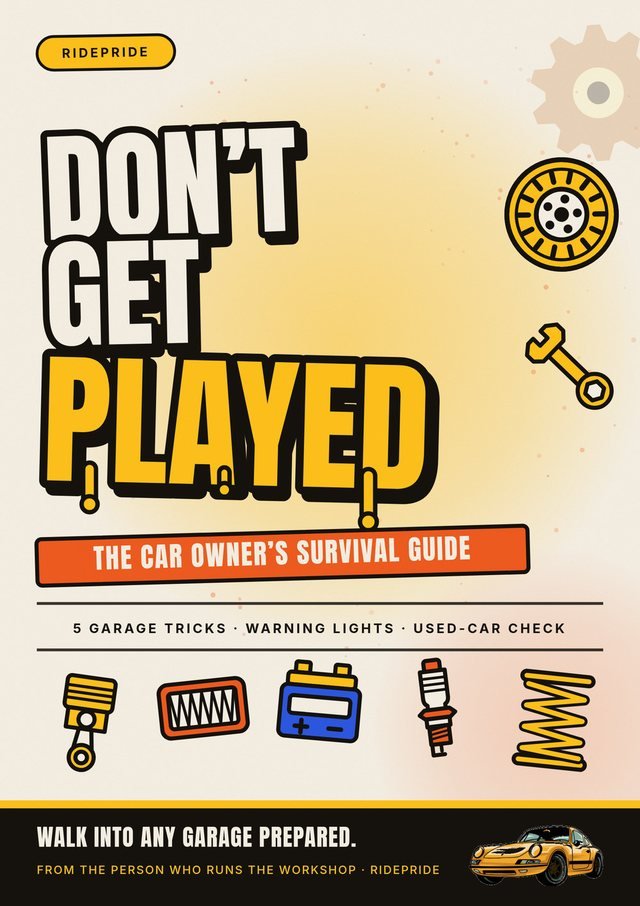
Guide · PDF · 24 pages
Don't Get Played
- The next time a mechanic hands you a list of seven faults, you'll know which two are real.
- How to read a quote, and six questions that protect you at any garage.
- Every dashboard warning light, sorted by how urgent it really is.
- A step-by-step check for buying a used car, before you hand over a shilling.
Instant PDF download · A4 and phone editions · Secure checkout on Payhip
Comments
Join the conversation
Sign up free to ask a question or add what you know. Only your name is shown.